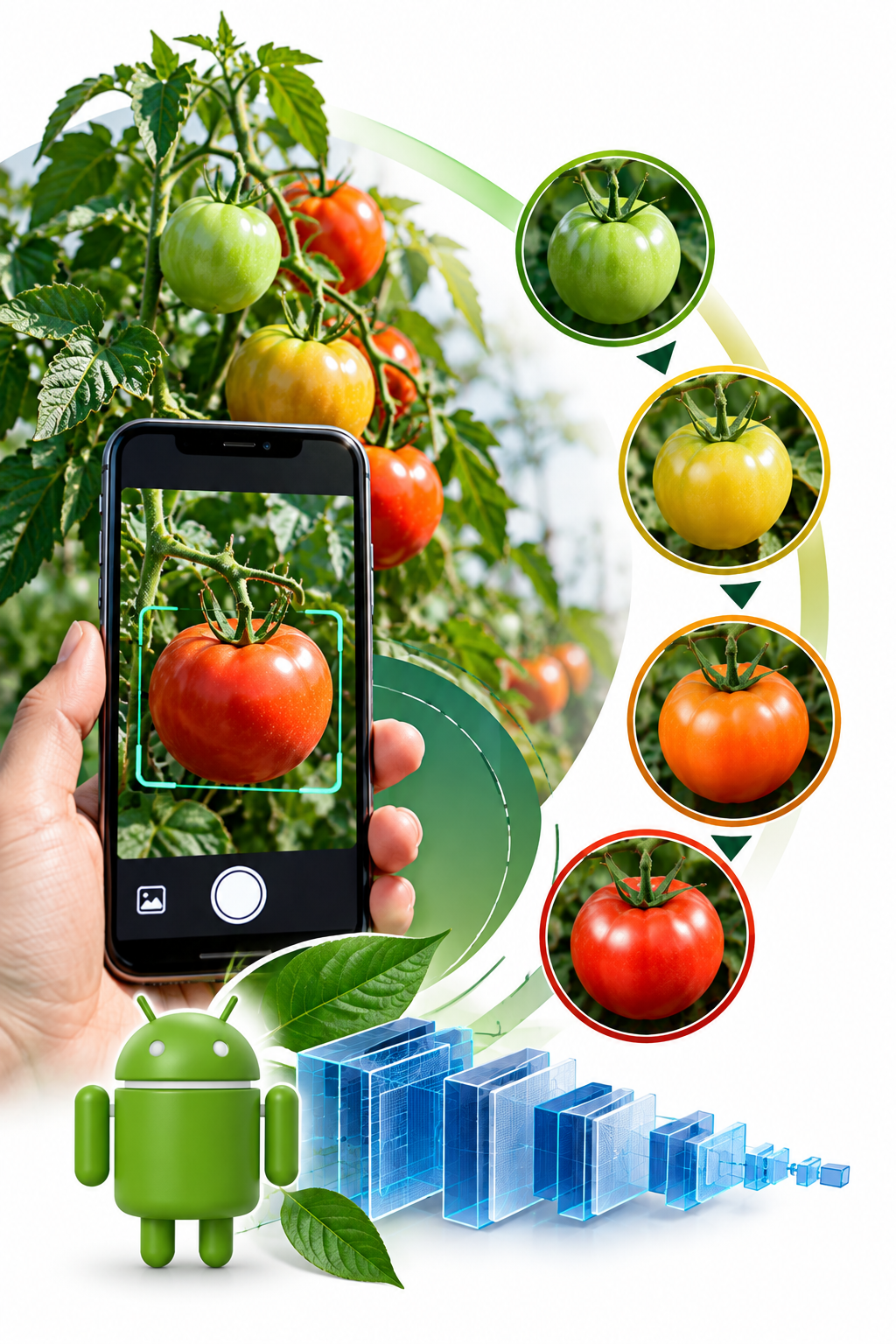
Android-Based Diamante Max Tomato Maturity Stages Classification Using the VGG-16 Model
Keywords
- android-based application
- diamante max tomato
- maturity stages classification
- vgg-16 model
Abstract
The study classified the diamante max tomato maturity stages
using the VGG-16 model; thus, an Android application was developed as a
portable classifier. Technology-based classification of the maturity stages of
tomatoes using the mobile application can lessen the time, provide further
information about the six (6) maturity stages of the tomato, and the accuracy
rate for the experimental result is 93.6%, indicating that it is comparable to the
application. The application was rated by the evaluators and achieved an
average mean score of 4.5 for functionality, an average mean score of 4.2 for
reliability, and an average mean score of 4.5 for usefulness, which indicates
that they were all in agreement that the application was highly working
effectively, improves identifying maturity stages of diamante max tomato, and
gave the purpose of the study. Furthermore, adding more varieties of tomatoes
will increase the application's usability, and the dataset must increase in each
maturity stage to provide a more comprehensive view of the data for future
researchers. For the application to be utilized as a smart farming solution, the
application must be integrated with automated harvesting systems to optimize
picking times.
References
Alatawi, A. A., Alomani, S. M., & Alhawiti, N. I. (2022). *Plant disease detection using AI-based VGG-16 model*. ProQuest. https://www.proquest.com/openview/33e6627686425a66f3b93d563d7d0d4d/1?pq-origsite=gscholar&cbl=5444811
Albashish, D., Al-Sayyed, R., Abdullah, A., Ryalat, M. H., & Ahmad Almansour, N. (2021). Deep CNN model based on VGG16 for breast cancer classification. In *2021 International Conference on Information Technology (ICIT)* (pp. 805–810). IEEE. https://doi.org/10.1109/ICIT52682.2021.9491631
Bayogan, E. R., Secretaria, L., Lequigan, D., & Abad, R. (2022). The use of brick-walled evaporative cooler for storage of tomato. *Journal of Horticultural Sciences, 17*(1), 190–198. https://doi.org/10.24154/jhs.v17i1.1230
Burzykowski, T., Geubbelmans, M., Rousseau, A.-J., & Valkenborg, D. (2023). Validation of machine learning algorithms. *American Journal of Orthodontics and Dentofacial Orthopedics, 164*(2), 295–297. https://doi.org/10.1016/j.ajodo.2023.05.007
Das, P., & Yadav, J. P. S. (2020). Automated tomato maturity grading system using CNN. In *2020 International Conference on Smart Electronics and Communication (ICOSEC)* (pp. 136–142). IEEE. https://doi.org/10.1109/ICOSEC49089.2020.9215451
Garcia, M. B., Ambat, S., & Adao, R. T. (2019). Tomayto, tomahto: A machine learning approach for tomato ripening stage identification using pixel-based color image classification. In *2019 IEEE 11th International Conference on Humanoid, Nanotechnology, Information Technology, Communication and Control, Environment, and Management (HNICEM)* (pp. 1–6). IEEE. https://doi.org/10.1109/HNICEM48295.2019.9072892
Guan, Q., Wang, Y., Ping, B., Li, D., Du, J., Qin, Y., Lu, H., Wan, X., & Xiang, J. (2019). Deep convolutional neural network VGG-16 model for differential diagnosing of papillary thyroid carcinomas in cytological images: A pilot study. *Journal of Cancer, 10*(20), 4876–4882. https://doi.org/10.7150/jca.28769
Huynh, D. P., Vo, M. V., Dang, N. V., & Truong, T. Q. (2021). Classifying maturity of cherry tomatoes using deep transfer learning techniques. *IOP Conference Series: Materials Science and Engineering, 1109*(1), Article 012058. https://doi.org/10.1088/1757-899X/1109/1/012058
Jiang, Z.-P., Liu, Y.-Y., Shao, Z.-E., & Huang, K.-W. (2021). An improved VGG16 model for pneumonia image classification. *Applied Sciences, 11*(23), Article 11185. https://doi.org/10.3390/app112311185
Mputu, H. S., Abdel-Mawgood, A., Shimada, A., & Sayed, M. S. (2024). Tomato quality classification based on transfer learning feature extraction and machine learning algorithm classifiers. *IEEE Access, 12*, 8283–8295. https://doi.org/10.1109/ACCESS.2024.3352745
Phan, Q.-H., Nguyen, V.-T., Lien, C.-H., Duong, T.-P., Hou, M. T.-K., & Le, N.-B. (2023). Classification of tomato fruit using YOLOv5 and convolutional neural network models. *Plants, 12*(4), Article 790. https://doi.org/10.3390/plants12040790
Smith, L. N. (2018, March 26). *A disciplined approach to neural network hyper-parameters: Part 1—Learning rate, batch size, momentum, and weight decay*. arXiv. https://arxiv.org/abs/1803.09820
Wang, B., Gao, W., & Yang, B. (2022). Recognition method and application of wild vegetables based on lightweight convolutional neural network model. *Journal of New Media, 7*(2). https://bit.kuas.edu.tw/~jni/2022/vol7/s2/05.JNI0273_r1.pdf
Wei, M., Wang, H., Ma, T., Ge, Q., Fang, Y., & Sun, X. (2021). Comprehensive utilization of thinned unripe fruits from horticultural crops. *Foods, 10*(9), Article 2043. https://doi.org/10.3390/foods10092043
Worldwide total fresh tomato production in 2021—Tomato News. (2023). https://www.tomatonews.com/en/worldwide-total-fresh-tomato-production-in-2021_2_1911.html
Yang, H., Ni, J., Gao, J., Han, Z., & Luan, T. (2021). A novel method for peanut variety identification and classification by improved VGG16. *Scientific Reports, 11*, Article 15756. https://doi.org/10.1038/s41598-021-95240-y
You, K., Long, M., Wang, J., & Jordan, M. I. (2019, August 5). *How does learning rate decay help modern neural networks?* arXiv. https://arxiv.org/abs/1908.01878